- High class consonants list
- High class consonants rules
- High class consonants chart
- High class consonants example
- Summary high class consonants rules
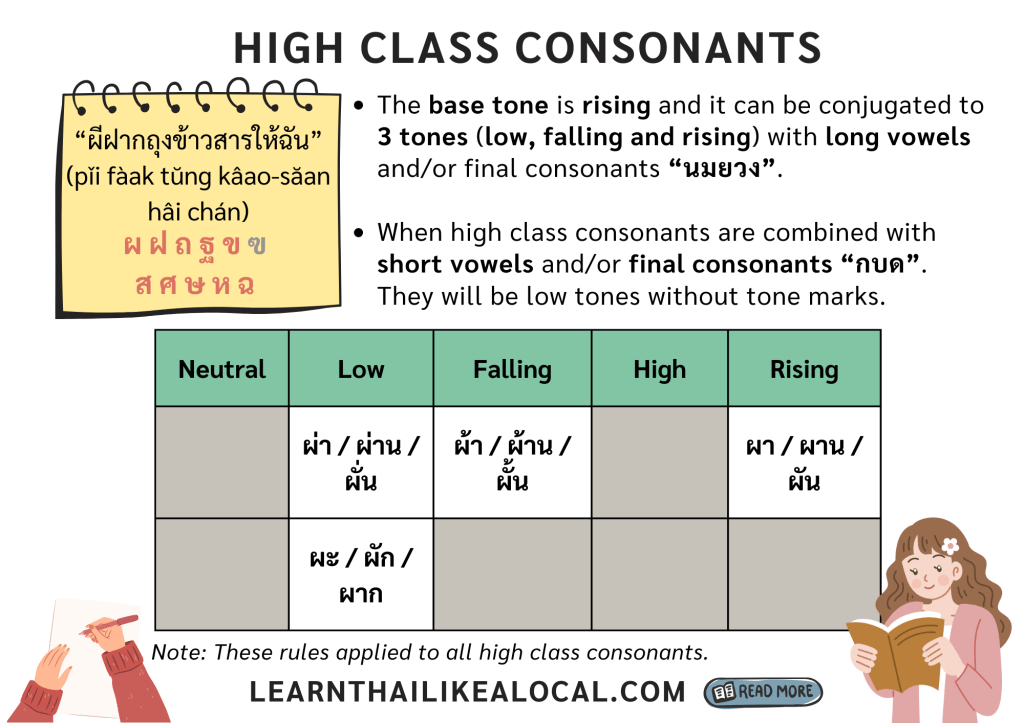
High class consonants in Thai has 11 consonants in total which are ผ ฝ ถ ฐ ข ฃ ส ศ ษ ห ฉ. However “ฃ” is obsoleted so it is not be used anymore. Thai people learned by remembering in a sentence as “the ghost leaves a bag of rice to me = pǐi fàak tŭng kâao-săan hâi chán (ผีฝากถุงข้าวสารให้ฉัน).
Let’s learn Thai about high class consonants through a chart and examples to understand more about the reading rules and be able to understand how to read the words with Thai high class consonants better.
High class consonants list
- ผ = păaw pêung (ผอ ผึ้ง)
- ฝ = făaw făa (ฝอ ฝา)
- ถ = tăaw tŭng (ถอ ถุง)
- ฐ = tăaw tăan (ฐอ ฐาน)
- ข = kăaw kài (ขอ ไข่)
- ส = săaw sǔuea (สอ เสือ)
- ศ = săaw săa-laa (ศอ ศาลา)
- ษ = săaw ruue-sǐi (ษอ ฤาษี)
- ห = hăaw hìip (หอ หีบ)
- ฉ = chăaw chìng (ฉอ ฉิ่ง)
First thing is to know what Thai alphabets are in Thai class consonants and what those sounds are in English so you can remember the sound of each consonant better.
Practising and familiarising through writing them helps you remember them better and also practise writing skill a bit since the beginning as well.
High class consonants rules
- The base tone is rising and it can be conjugated to 3 tones (low, falling and rising) with long vowels and/or final consonants “นมยวง”.
- When high class consonants are combined with short vowels and/or final consonants “กบด”. They will be low tones without tone marks.
Let’s take a look at the chart below for a better picture!
High class consonants chart
High class consonants with long vowels, short vowels and main final consonants
| Neutral | Low | Falling | High | Rising |
| ผ่า / ผ่าน / ผั่น | ผ้า / ผ้าน / ผั้น | ผา / ผาน / ผัน | ||
| ผะ / ผัก / ผาก |
Note: These rules applied to all high class consonants.
High class consonants example
- ผา (păa) = cliff
- ผ้า (pâa) = fabric
- ผ่าน (pàan) = pass
- ผัก (pàk) = vegetables
- ฝัน (făn) = dream
- หาก (hàak) = if (official)
- สี (sĭi) = color
- ถูก (tùuk) = cheap
- ขับ (kàp) = drive
- ข้าว (kâao) = rice
Summary high class consonants rules
- High class + long vowels / high class + long vowels + “นมยวง” / high class + short vowels + “นมยวง”= start from rising tones without tone marks (as it’s original sounds of the consonants) + low and falling with direct tone marks
- High class + short vowels / high class + short vowels + “กบด” / high class + long vowels + “กบด” = only one tone as low tone without tone marks
- There are no neutral and high tones with high class consonants as they belong to low class consonants.
After you learn about the middle class consonants, the next step is to learn about Thai high class consonants. As if you remember middle class consonants and high class consonants, it will be easier as the rest will be low class consonants which apply pretty much the same rules on how to read.
If you want to learn Thai on how to read Thai in a fun practice book and with an experienced Thai teacher for foreigners, try a trial class with Learn Thai Like A Local and learn Thai online how to read and write Thai in a fun yet effective way that could be something you are looking for!
 Learn Thai Like a Local
Leave a comment